
What Is Apathy?

Apathy is one of the most common symptoms of dementia, affecting approximately half of people with dementia, although rates vary by dementia type and stage.
Apathy is a neurological symptom involving reduced:
Motivation and initiation
Interest in activities
Emotional responsiveness
A person with apathy may sit for long periods, stop hobbies, need prompting for personal care, or appear uninterested in activities they once enjoyed.
Apathy Is NOT Laziness…. Dementia can affect the brain networks responsible for motivation, planning, and initiating actions. A person may still know how to do something but be unable to independently get started.
For example: “I know how to shower.”
does not necessarily mean: “I can recognize that I need to shower, gather what I need, begin the task, and complete it.”
The person may not be choosing not to participate. Their brain may no longer reliably generate the initiation needed to begin.
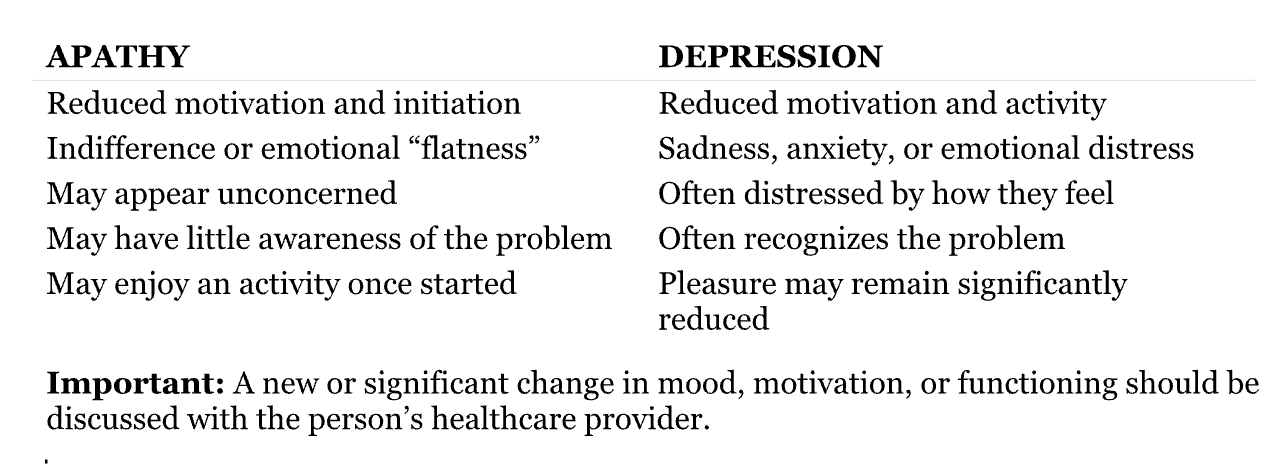
APATHY VS. DEPRESSION
Apathy and depression can look similar, and both can occur in the same person.
6 WAYS TO HELP WITH APATHY
1. PROVIDE THE FIRST STEP
Don’t wait for the person to initiate…. Hand them the toothbrush. Put the shoes by the door. Place the shirt in their hands. In other words, make the first step obvious.
2. BREAK TASKS INTO SMALL STEPS
Avoid giving multiple instructions at once. Instead of:
“Go upstairs, get dressed, brush your teeth, make your bed, and come downstairs.”
Try: “Let’s get dressed.”
Then provide the next step. One step → complete → next step.
3. USE A PREDICTABLE ROUTINE
A consistent routine reduces decision-making and creates familiar cues.
For example:
Morning: Bathroom → dressed → breakfast
Midday: Lunch → activity → rest
Afternoon: Walk → household activity
Evening: Dinner → relaxing activity → bedtime
Predictability reduces the need to figure out what comes next.
4. LET THE ENVIRONMENT PROVIDE THE CUE
Set things up so the environment helps communicate what to do.
Brush teeth: Toothbrush + toothpaste visible
Get dressed: Clothes laid out in order
Go for a walk: Shoes + jacket by the door
The environment can become part of the cueing system.
5. START WITH FAMILIAR, MEANINGFUL ACTIVITIES
Try activities that require little explanation:


Favorite music
Walking
Gardening
Folding towels
Looking through photographs
Simple household tasks
Pet interaction
Baking
Reminiscing
Sorting familiar objects
The goal is engagement—not productivity.
6. USE FEWER WORDS & MORE ACTION
Too much explanation can increase cognitive demands.
Instead of: “You really need to take a shower because…”
Try: “Let’s take a shower.”
Then demonstrate or begin the first step.
Focus on: Short words + simple directions + demonstration
WHEN SOMEONE SAYS “NO”
Don’t automatically assume “no” means won’t. “No” may mean:
“I don’t understand.”
“I don’t know how to start.”
“This feels overwhelming.”
“I’m tired.”
“I’m embarrassed.”
“I genuinely don’t want to.”
Try changing how you approach the activity before assuming the person is being difficult.
THE TAKEAWAY
Apathy is a brain-based symptom—not laziness or simply a lack of effort. A person may still have the ability to participate but need someone else to provide the initiation, structure, and first step.
WHEN TO CONTACT A HEALTHCARE PROVIDER
Talk with the person’s healthcare provider about a new or significant change in motivation, mood, or participation, especially with:
New or worsening sadness or anxiety
Major sleep or appetite changes
Sudden confusion
Significant functional decline
Increased fatigue
Medication changes
Other new medical symptoms
Apathy, depression, medication effects, and medical conditions can sometimes look similar.
RESOURCES
Alzheimer’s Society - Apathy and Dementia https://www.alzheimers.org.uk/about-dementia/stages-and-symptoms/apathy-dementia
Alzheimer’s Association - Dementia & Caregiver Resources https://www.alz.org/
Dementia Australia- Mood and Behaviour Changes https://www.dementia.org.au/living-dementia/mood-and-behaviour-changes
van Dalen, J. W., et al. (2018). - Apathy in dementia: A systematic review and meta-analysis. Journal of Neurology, Neurosurgery & Psychiatry, 89(4), 389–396. https://pmc.ncbi.nlm.nih.gov/articles/PMC8888661/
Apathy and Depression in Neurocognitive Disorders - Peer-reviewed review. https://pmc.ncbi.nlm.nih.gov/articles/PMC10107127/
Susan Raychard, MOTR/L, CDP Board-Certified Occupational Therapist | Certified Dementia Practitioner
